How to Protect Crops and Farm Mana: Scarecrows and Gobblers
Secure your magical harvest from crows by unlocking the Scarecrow blueprint, and master the daily routines of feeding the Gobbler plant for efficient mana farming.
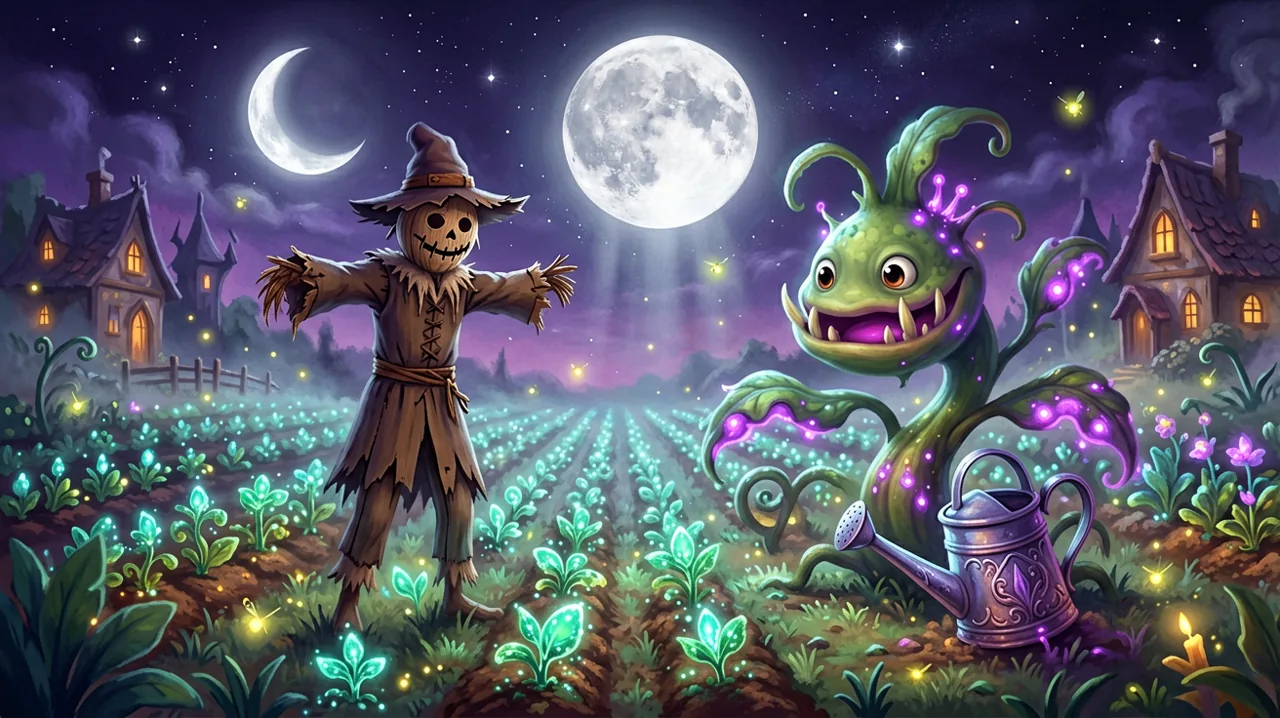
As players settle into their new supernatural life, the transition from a mundane existence to managing a magical homestead brings a host of unique challenges. While cultivating a farm in the dead of night is inherently atmospheric, it is not without its perils. In the gothic town of Moonlight Peaks, your carefully tended enchanted crops are constantly at risk from nocturnal pests, and sustaining your magical abilities requires a steady influx of resources.
Recent official insights and community strategies have highlighted two critical aspects of magical agriculture: protecting your harvest with Scarecrows and maximizing your spellcasting potential by cultivating the highly demanding Gobbler plant. Whether you are a novice vampire just learning how to wield a hoe or a seasoned witch looking to optimize your mana output, understanding how these farming mechanics interact is essential for a thriving homestead.
The Menace of the Night: Crows and Crop Destruction
In many traditional farming simulations, pests are treated as a minor nuisance or an aesthetic touch. However, in the gothic world of Moonlight Peaks, the local wildlife is significantly more aggressive. Crows, a staple of the spooky aesthetic, are officially confirmed to be one of the primary threats to your growing crops. When left unprotected, these feathered scavengers will descend upon your fields, consuming valuable seeds and destroying fully grown plants before you have a chance to harvest them.
This destruction can be devastating to your in-game economy, especially when you are cultivating rare magical flora that takes several nights to mature and requires significant investments of enchanted resources. Community-reported instances suggest that crow attacks happen primarily during the twilight hours when the player is off exploring the catacombs, running errands for the seven founding families, or socializing with the local supernatural residents.
If you return to your farm and find empty tilled soil where your precious seeds used to be, you have likely fallen victim to these pests. To prevent this, players must invest in proper crop defense mechanisms early in their playthrough. This makes the Scarecrow not just a decorative item for your gothic aesthetic, but a mandatory tool for any serious agricultural endeavor. If you are still figuring out the basics of tilling soil and planting seeds in the moonlight, you should review our basic overview on farming and enchanted crops.
Crafting the Perfect Defense: Unlocking the Scarecrow Blueprint
To safeguard your farm, you need to construct a Scarecrow. This essential item is not available by default when you first inherit your plot of land. Players must first unlock the blueprint. While the exact questline is still being mapped by players, it is expected to be tied to early-game farming progression milestones or obtained through completing specific requests via the jobs and job board.
Once the blueprint is secured, you will need to gather the necessary crafting materials. The recipe requires players to stockpile basic resources like wood and plant fibers, but given the game’s theme, it reportedly also requires spookier materials that fit the gothic aesthetic. You might need to spend a few nights foraging in the dark woods to gather all the components.
Placement strategy is another crucial factor. A single Scarecrow has a limited radius of protection, meaning that as your farm expands into a massive agricultural operation, you will need to craft multiple units to cover all your crop fields. It is heavily recommended to place your most valuable crops—such as the rare ingredients needed for high-level potions—near the absolute center of the Scarecrow’s radius. As you upgrade your equipment through the tools and upgrades system, you might find ways to optimize your layout further. Ensuring that your fields are fully covered allows you to freely explore the town, complete storyline quests, and participate in festivals without constantly worrying about the safety of your hard-earned harvest.
The Gobbler: Your Magical Companion and Mana Source
While protecting your standard crops like pumpkins and nightshade is important, some plants require a vastly more hands-on approach. Enter the Gobbler, officially noted as one of the most valuable and unique magical plants available in the game. Unlike standard vegetables that simply require tilled soil and a quick splash from your standard watering can, the Gobbler is a sentient, carnivorous plant that demands daily attention. Growing a Gobbler is a major commitment, but the rewards are completely worth the effort, as it serves as a primary generator for mana.
Cultivating a Gobbler involves a strict regimen. According to recent guides, this demanding plant requires both feeding and magical watering. Normal water from your well will simply not suffice; you must use magically imbued water, which players can eventually craft or gather once they advance their skills.
Furthermore, the Gobbler lives up to its name by requiring daily feeding. While the optimal diet is still being experimented with by the community, it is expected that the Gobbler consumes a variety of items ranging from common insects caught with your bug net to specific types of fish. This adds a compelling layer of complexity to your daily routine, as you must balance your time between tending to crops and heading out for fishing and foraging to ensure your Gobbler is consistently well-fed.
Mana Farming Strategies with the Gobbler
Why go through all this trouble for a single, demanding plant? The answer lies in the concept of mana farming. Mana is the absolute lifeblood of your supernatural abilities in this game. Whether you are brewing complex elixirs, casting utility spells to water crops instantly, or utilizing your traversal abilities like shapeshifting into a bat, your mana pool is constantly being depleted.
While there are various ways to restore mana—such as resting in your coffin or consuming specific crafted potions—the Gobbler offers a renewable, daily source of magical energy right on your doorstep. When properly fed and given magical water, the Gobbler produces a significant amount of mana that can be reliably harvested each night.
By planting multiple Gobblers and strictly maintaining their feeding schedules, players can create a highly efficient mana farm. This surplus of magical energy allows you to engage more frequently in spellcasting, giving you a distinct advantage when navigating the more challenging aspects of the game or trying to speed up production. For players looking to maximize their magical potential rather than just hoarding gold, dedicating a specific portion of your farm exclusively to Gobblers is a highly recommended strategy. For more details on how to utilize your newly acquired magical energy, check out our comprehensive overview on mana and spellcasting.
Managing Your Harvest: Storage Quirks and Community Solutions
As your farming operations expand and you start hoarding resources to feed your Gobblers and craft Scarecrows, you will inevitably run into storage management issues. Inventory space has been a hotly debated topic within the community, especially following the recent patch 1.1.41 storage overhaul.
A common issue currently being reported on Reddit and community forums involves the “unlimited storage” feature of the player’s house. Many players have noted that they are unable to store items when standing outside their house, or they find that the option to store items inexplicably vanishes entirely after reaching a certain threshold. It is currently unconfirmed whether this is an intended mechanic designed to encourage localized storage management, or simply an interface bug that needs addressing in an upcoming hotfix.
In the meantime, players are advised to manually craft multiple specialized storage chests for different categories of items. Dedicate one chest for standard seeds, one specifically for Gobbler food (like bugs and fish), and another for crafting materials needed for Scarecrows. Keeping a well-organized, color-coded inventory system will save you precious time during the game’s short night cycle, ensuring that you always have the necessary supplies on hand before the sun comes up.
Looking Ahead
The intricacies of farming in Moonlight Peaks continue to evolve as players test the limits of the game’s mechanics. Some in the community speculate that future updates might introduce new variations of the Scarecrow with wider ranges, or additional sentient plants that rival the Gobbler in both complexity and reward. There are also high hopes that the storage system will receive further clarity from the developers to make farm management smoother and more intuitive.
Until then, mastering the current agricultural systems is your best path to financial and magical success. By diligently protecting your fields with Scarecrows and optimizing your mana production through Gobblers, you can establish a thriving homestead that serves as the perfect foundation for uncovering the secrets of the seven founding families. Stay tuned to our hub for the latest updates as we continue to track everything happening in town.